


John Williams' "Minority Report" - 4M1 The Greenhouse Scene (measures 18-36)
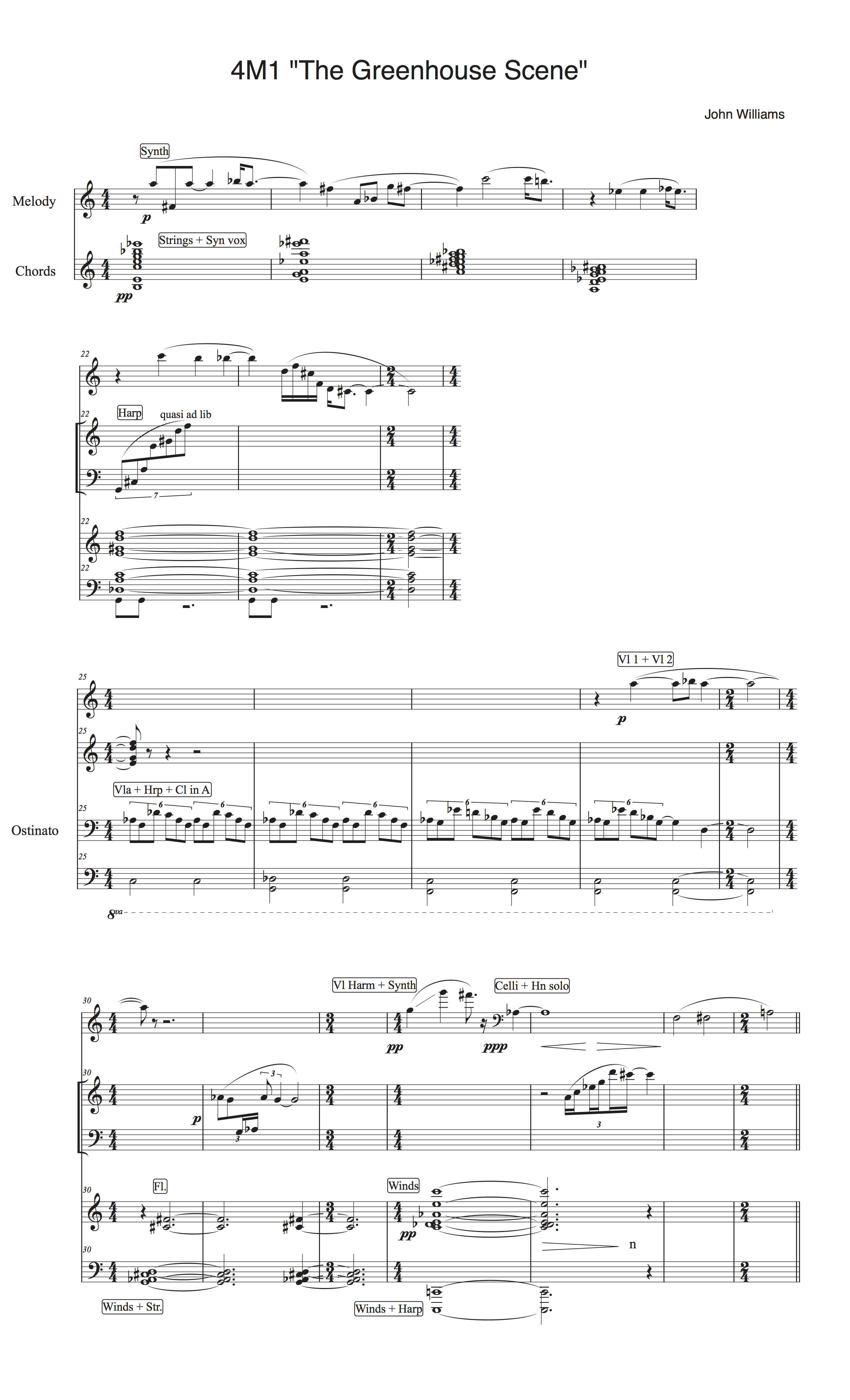
Harmony:
- Use of extremely dissonant harmonies
- Chords typically use minor seconds and tritones to create dissonance
- Chords can use dense voicings in the low register
- Writing techniques from twentieth-century concert music—such as clusters—are commonly used
In Suspense/horror music, we're diving into the world of contemporary music, and there's a lot of systems and approach to it. Whether it's serialism, poly-tonality, atonality, aleatoric music or spectral music - to name a few - two main principles emerge:
- The central role of tonality is gone and subsequently the function of the tonic (fundamental) and the concept of degrees goes out the window. This can seem disturbing for some. If there's no central notes, it's confusing to understand movement, tension/resolution. It's almost like being in a no gravity zone.
- It's a very wild environment for musical objects. In that context, the loudest voice and biggest guns rule. The weapons of choice are dissonances, more specifically the semi-tone [in 3 forms: b2 (pure), M7 (octave -b2) and b9 (octave+b2) ] and the tritone.
One crucial role of the composer is to organize and put some constraints to the handling of dissonances. Many systems have been explored and described by theoreticians and composers and each system will produce a different type of music, which doesn't make things easier for us. But for the sake of clarity and to keep things relatively simple, we're proposing the following approach and focus on three major elements:
- The quantity of dissonances presented in the chord structures
- The density of the chord - how many notes are packed within its ambitus - closed vs. open positions
- The degree of connection between the melody and the chord - how many notes from the melody are to be found in the harmony
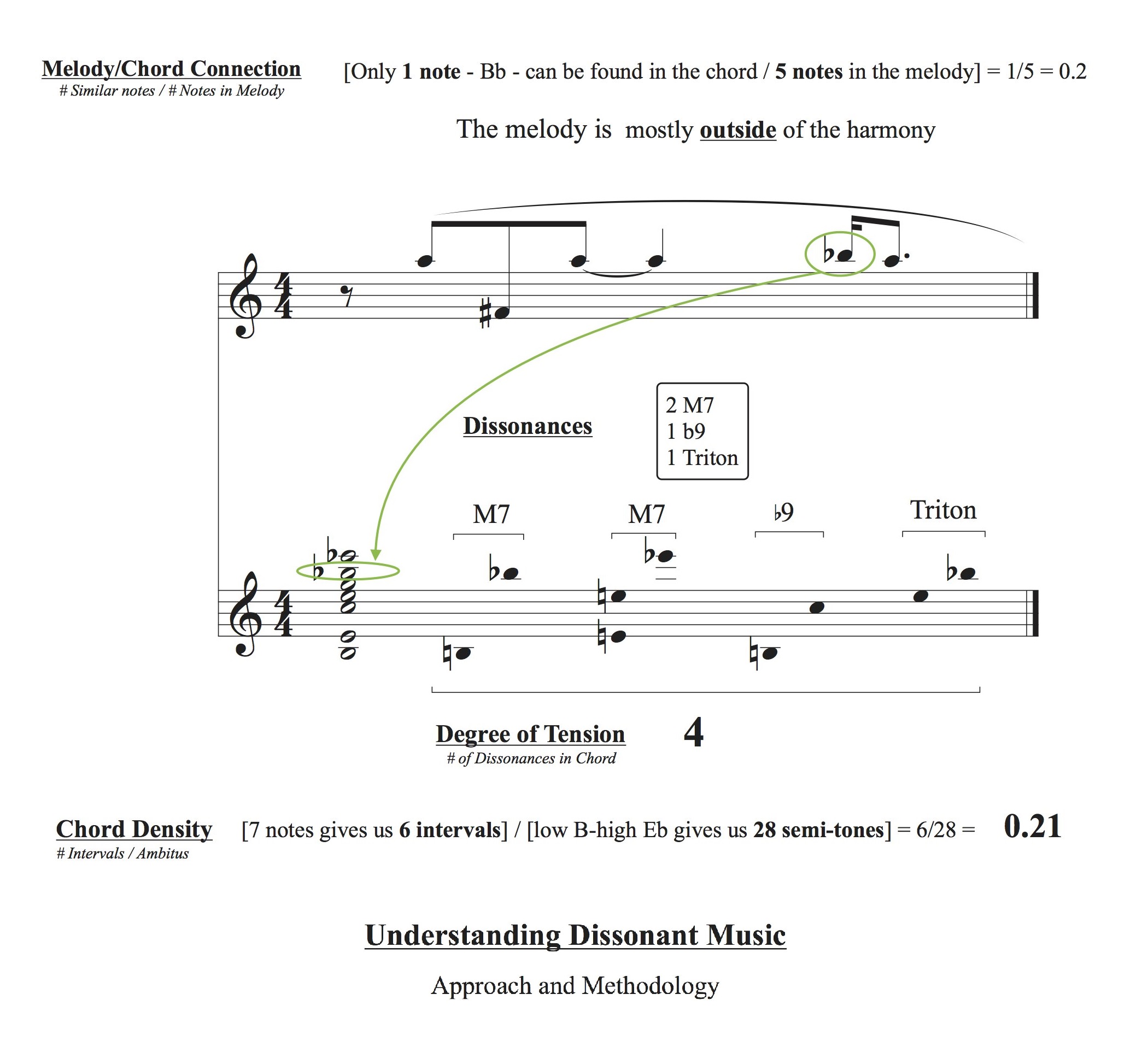
In a nutshell, we're trying to assess how tensions evolve in a piece as the listener can experience it.
A quick side note - tensions will be dampened by the following factors:
- when both notes of a dissonance belong to other dissonances in the chord. In our previous example, both notes of the tritone are a part of the M7. The tritone get 'swallowed' by the other dissonances and effectively bring the perceived degree of tension down from 4 to 3.
- when the chord spreads out. In that case, there is more room for pitch separation. It's a great way to 'soothe' a very tensed chord.
- instrumentation: strings and synth pads will soften the clusters while brass will harshen the dissonant chords
At this point I would suggest listening to the full chord sequence a few times (link below) and train your ears to appreciate the various degree of tensions. I personally found it easy to spot the third chord as carrying more tension. I also think it's harder to identify the last chord as the one being loaded with the most dissonances, but after a few passes, one can make that distinction.
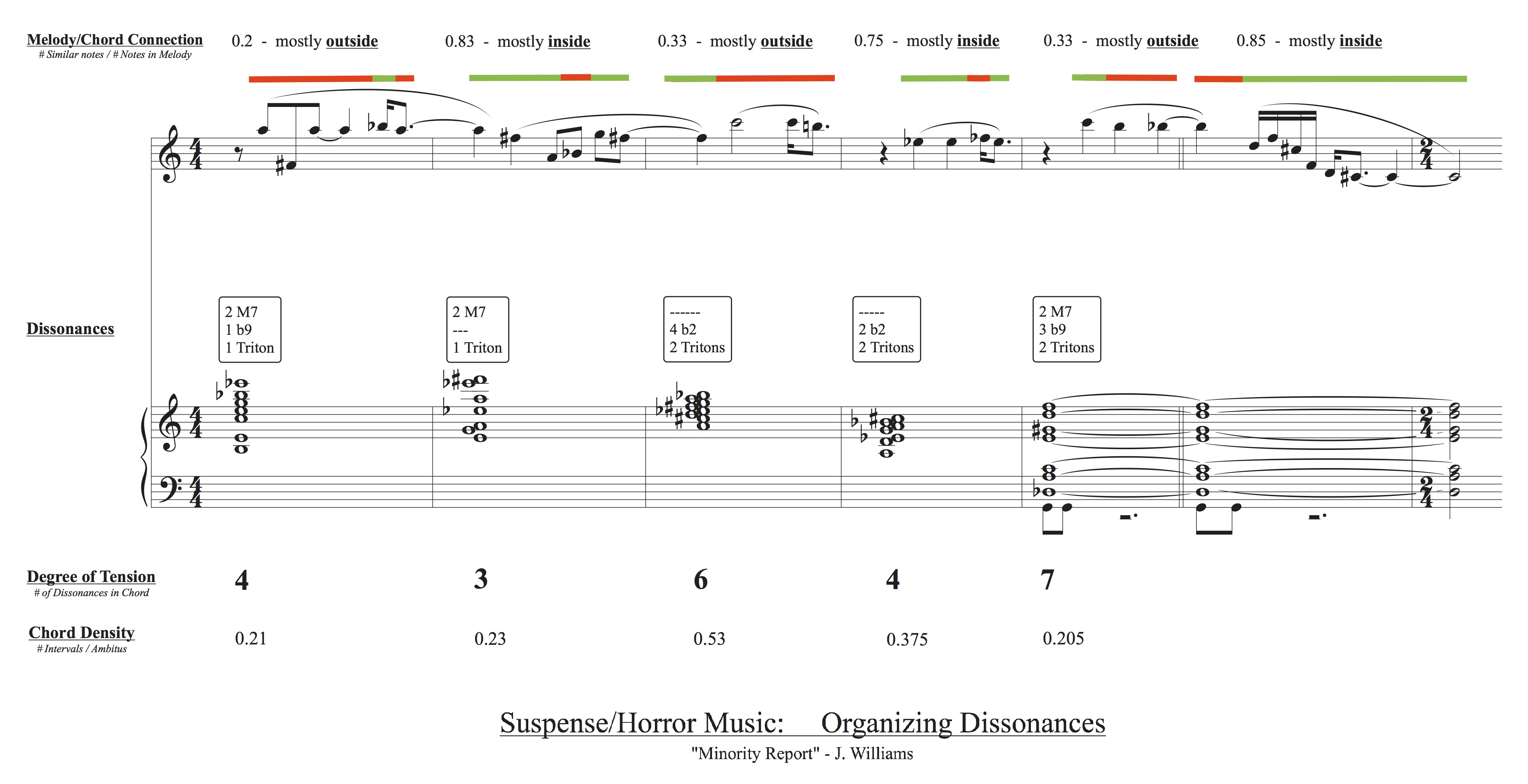
So, all those maths are fine, but really, what do we take away?
- The degree of tensions builds from 4 to 7
- The melody shows a pattern of 'call and response' - alternating between being Outside / Inside the harmony
- The last chord is spread out which effectively soothes its intensity AND the last melodic phrase stays entirely inside the chord - like swallowed by it.
- It's not random. As abstract as this music can seems to be, the logic exposed here reveals that the composer was detailed in his craft.
So, the last word and the key to this music is abstract and figurativism. As in abstract painting, atonal type of music will remove familiar objects and focus more on sonic textures and relationships between musical objects.
In John William's cue, we can easily personify the melody and the chords to let's say the main character vs the environment (the greenhouse). The tensed chords would mirror the weirdness of the greenhouse (the plants are genetically modified and behave like moving creatures). The alternating pattern of the melody could illustrate the fight between the hero and the plants trying to control/seduce him - leading to the total engulfment of the melody by the final chord suggesting that the main character is being seduced by the environment (the Greenhouse).
Of course, any narrative one can make is subjective and may not reflect the actual thinking of the composer. The most important thing is that a structure and a logic is being revealed and expressed in the piece.